
Last updated June 28, 2026
Seasonal Garage Door Care for Miami: Year-Round Homeowner’s Guide
Every June, our phone starts ringing with the same kind of call: a homeowner in Kendall or Hialeah who just got a storm watch notification and is now discovering their hurricane-rated door has a snapped spring, a bent strut, or a bottom seal that’s been shredding since February. The preparation window — that calm stretch between April and early June — was right there, and it passed unused. Miami’s garage door calendar is genuinely different from the rest of the country’s, and the homeowners who treat it that way avoid most of the expensive surprises. This guide gives you the exact tasks, timed to Miami’s actual climate, so you’re never caught short when a named storm is 48 hours out.
Quick Answer
Seasonal garage door maintenance in Miami means splitting your year into two distinct threat windows: hurricane season (June–November), which demands wind-load hardware inspections, auto-reverse tests, and seal integrity checks before storms arrive — not during them — and the dry season (November–March), when UV damage, aluminum track expansion, and opener heat stress need attention. Completing one focused inspection in late April and a second in November covers the vast majority of what Miami’s climate can throw at a residential garage door.
Table of Contents
- Why Miami’s Climate Demands a Different Maintenance Calendar
- Pre-Hurricane Season Inspection (April–May): The Wind-Load Checklist
- How to Test Your Door’s Auto-Reverse and Hurricane Lock Before Storm Season
- Post-Storm Inspection: What to Check Before You Operate the Door Again
- Dry-Season Tasks (November–March): What Most Miami Homeowners Skip
- Re-Lubricating After Wet Season: The One Task Almost No One Does
- Common Mistakes to Avoid
- When to Call a Professional
- Frequently Asked Questions
- The Bottom Line
Why Miami’s Climate Demands a Different Maintenance Calendar
Most garage door maintenance guides are written for climates with hard winters — frozen springs, cracked seals from ice, rust from road salt. Miami has none of that. What Miami does have is a punishing combination of high humidity, sustained UV intensity, salt air (especially in Coconut Grove, Miami Beach, and Brickell-adjacent neighborhoods), and a six-month hurricane season that can generate 150-mph wind loads against a door that spans the widest opening on most homes.
The result is a two-phase threat calendar that looks nothing like the national norm:
- Threat Window 1 — Hurricane Season (June 1–November 30): Wind-load hardware failure, seal breach during storm surge, opener damage from power surges, and panel flex on doors that weren’t properly braced are the primary risks.
- Threat Window 2 — Dry Season (December–March): UV degradation of bottom seals and vinyl weatherstripping, thermal expansion in aluminum tracks from the temperature swing, and opener motor stress from heat buildup in enclosed garages define this period.
In our experience working across Miami for over two decades — from Doral to Pinecrest, from Little Havana to North Miami Beach — homeowners who maintain on this two-phase schedule spend significantly less on emergency repairs than those who follow a generic once-a-year routine. The tasks are straightforward. The timing is everything.
Pre-Hurricane Season Inspection (April–May): The Wind-Load Checklist
April and May are your preparation window. Tropical storm activity is statistically low, parts are in stock, and scheduling a technician takes days rather than hours. By June 1, this inspection should be complete. Here’s what it covers — and why each item matters specifically in Miami’s wind environment.
Wind-Load Hardware: The Four Things That Hold the Door Together in a Storm
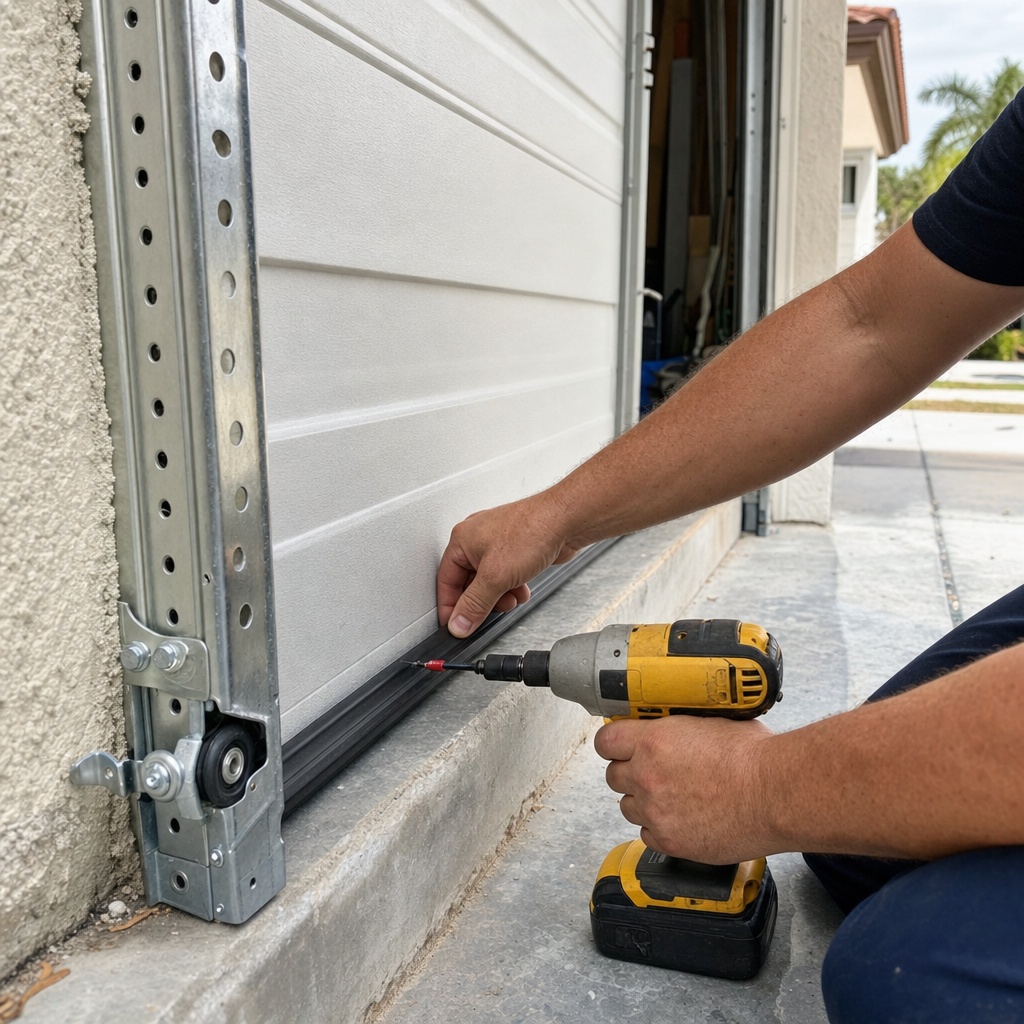
- Hinges: Standard hinges on a residential garage door are rated for normal operational stress. In Miami, doors in the Miami-Dade High-Velocity Hurricane Zone (HVHZ) require hinges rated to the door’s specific wind-load specification. Check each hinge for cracks at the barrel, missing or stripped screws, and any visible corrosion. Salt air accelerates corrosion on steel hinges faster than you’d expect — especially within a mile of Biscayne Bay or the Atlantic coast.
- Track Brackets: The horizontal and vertical track brackets anchor the door’s travel path to the wall framing. A bracket that’s loose by even a quarter inch can allow enough flex under wind pressure to disengage the door from the track entirely. Tug each bracket by hand. Any movement means the lag screws need to be pulled, the holes filled, and the bracket reset into solid wood framing or concrete anchor.
- Horizontal Struts: Struts are the horizontal steel reinforcement bars that span the back of each door section. Without them, wind pressure bows the panels inward — potentially catastrophically. Clopay, Amarr, and Wayne Dalton doors manufactured for the Florida market typically ship with struts; older doors may have them as add-ons. Check that every strut is securely fastened at each end and shows no visible cracking or weld failure at the bracket points.
- Bottom Retainer and Bottom Seal: The bottom retainer holds the rubber or vinyl bottom seal. In a storm, a compromised bottom seal allows water intrusion at grade level — a serious issue in low-lying areas of Miami like parts of Wynwood, Allapattah, and Miami Shores. Inspect the retainer for bends or separation from the door bottom, and run your hand along the seal length to feel for cracks, chunks missing, or sections that have hardened to the point they no longer compress.
Additional April–May Checks
- Inspect all torsion or extension springs for visible corrosion, gaps in the coil, or uneven winding
- Test manual release cord operation — you need to be able to disengage the opener if power is out
- Confirm all cable drums are seated properly and cables show no fraying
- Verify opener surge protector is in place (critical in Miami’s lightning-active environment)
How to Test Your Door’s Auto-Reverse and Hurricane Lock Before Storm Season
Testing these two safety mechanisms takes under five minutes and should happen every April — not the morning a storm warning is posted.
Auto-Reverse Test (Mechanical and Electronic)
- Place a 2×4 flat on the garage floor in the door’s path, centered under the door.
- Close the door using the wall button or remote.
- When the door contacts the 2×4, it must reverse direction within two seconds. If it doesn’t reverse, or if it reverses sluggishly, the close-force sensitivity on the opener needs adjustment — a standard setting on LiftMaster, Chamberlain, Genie, and Craftsman units.
- For the photoelectric sensor test: with the door closing, wave a broom handle through the sensor beam about six inches off the floor. The door must reverse immediately. If it doesn’t, clean the sensor lenses first (Miami dust and humidity film the lenses quickly) then retest. Persistent failure means sensor alignment or replacement.
Hurricane Lock / Manual Lock Test
- With the door fully closed and the opener disengaged (pull the red release cord), engage the manual slide locks on each side of the door.
- Push firmly at the center of the door from the inside. There should be minimal flex — a properly locked, strut-reinforced door in HVHZ compliance will feel solid.
- Confirm the slide lock bars travel their full range and engage cleanly with the track slots. Bent or corroded lock bars that don’t fully engage are a common finding we see across older homes in Coral Gables and South Miami.
- Re-engage the opener after testing.
If your door lacks slide locks or the existing hardware is compromised, this is a pre-June repair — not a storm-week emergency.
Post-Storm Inspection: What to Check Before You Operate the Door Again
After any hurricane, tropical storm, or severe squall line passes through Miami, do not operate your garage door opener until you’ve completed a visual inspection. Debris impact, pressure differential during the storm, and power surge events can all create conditions where operating a damaged door makes the damage significantly worse — or creates a safety hazard.
Step-by-Step Post-Storm Protocol
- Exterior visual sweep: Walk the full exterior width of the door before touching anything. Look for dented or bowed panels, visible track displacement, debris lodged in the track, and any separation between the door frame and the wall framing.
- Check the bottom seal and threshold: Storm surge and wind-driven rain commonly force the bottom seal out of the retainer. A displaced seal still in the track can jam the door on first operation.
- Inspect the springs and cables: From inside, without operating the door, look up at the spring assembly and both lift cables. A broken spring is immediately visible — there’ll be a gap in the coil. Do not attempt to operate the door manually or with the opener if a spring is broken. This is true for LiftMaster, Raynor, Wayne Dalton — any brand. A door with a broken spring can drop without warning.
- Check the opener head unit: Look for water intrusion on the opener motor housing. Chamberlain and LiftMaster units have drainage weep holes, but a direct water hit can still compromise the logic board.
- Test manually first: Before running the opener, disengage it and lift the door by hand 12–18 inches. It should move smoothly and stay in place when you let go. Resistance, binding, or immediate dropping all indicate a mechanical issue that needs to be resolved before opener use.
- Run one slow opener cycle: Re-engage the opener and run one complete open-close cycle at normal speed, watching and listening throughout. Any grinding, popping, or jerking motion means stop and call for a professional inspection.
Dry-Season Tasks (November–March): What Most Miami Homeowners Skip
Once hurricane season officially ends in December, most Miami homeowners mentally check out of garage door maintenance until the following June. That’s exactly when the dry season’s quieter damage accumulates. Three issues are nearly universal in Miami during this period.
1. UV Seal Restoration
Miami averages around 3,000 hours of sunshine per year — one of the highest totals in the continental U.S. Rubber bottom seals, vinyl weatherstripping on the door sides and top, and any exposed rubber gaskets all experience accelerated UV degradation. By November, after five months of summer sun following the wet season, these components are typically at their most brittle.
The dry-season task: inspect every rubber and vinyl seal on the door. Press the material between your fingers — it should be pliable, not stiff. Cracked, brittle, or shrunken seals should be replaced before the next wet season. Replacement costs are low; water damage from a failed seal is not.
2. Aluminum Track Expansion Management
Miami’s temperature variance between a January night (low 60s) and a July afternoon (mid-90s) is about 35–40 degrees Fahrenheit. Aluminum tracks expand and contract with this range. Over years, the repeated thermal cycling works loose the lag screws holding track brackets to the wall. In the dry season, check every bracket for tightness. While you’re there, verify that the track gap — the space between the door rollers and the inside edge of the track — is consistent at roughly 1/4 inch. Tracks that have shifted from thermal movement may need to be re-plumbed.
3. Opener Cooling and Ventilation Check
Miami garages get hot. An enclosed garage in Doral or Hialeah on a July afternoon can easily reach 110–120°F. Opener motor units aren’t designed for sustained operation in extreme heat, and the dry-season inspection is a good time to check that the unit’s ventilation slots are clear of debris, spider webs, and dust accumulation that built up during the wet season’s humidity. LiftMaster, Chamberlain, and Genie units all have vented housing; a clogged unit runs hotter and shortens motor life.
Re-Lubricating After Wet Season: The One Task Almost No One Does
This is genuinely the most-skipped maintenance task we encounter across Miami, and it matters more here than anywhere else in the country. Here’s why: Miami’s wet season (roughly May–October) subjects a garage door’s metal components to near-daily humidity exposure, frequent moisture contact, and salt air if you’re within a few miles of the coast. Lubricant applied in January gets washed, diluted, and displaced by October. Re-lubricating in November — as the wet season ends — is the correct Miami protocol, not an optional extra.
What to Lubricate and What to Use
- Torsion spring coils: A thin coat of white lithium grease along the full length of the spring. Spray directly into the coils; a light coat is enough. Do not over-apply — excess lubricant attracts dust that becomes an abrasive paste.
- Rollers: Nylon rollers need no lubrication. Steel rollers need a small amount of white lithium or silicone-based spray at the bearing point only — not the shaft or the track.
- Hinges: Pivot points only. One light spray per hinge.
- Tracks: Do not lubricate the inside surface of the tracks. This is a common mistake. Lubricated tracks cause rollers to slip rather than roll, which creates jerky operation and wears rollers faster.
- Top of door lock bar: A small amount of lubricant where the bar contacts the track slot.
- What not to use: WD-40 is a solvent/water displacer, not a long-term garage door lubricant. In Miami’s heat and humidity, it evaporates quickly and can leave residue that attracts grit. Use a dedicated garage door lubricant spray, white lithium grease, or silicone-based products rated for high-temperature environments.
Proper lubrication reduces spring fatigue, extends roller life, and quiets the door significantly. In our experience at North Star Garage Door Repair Miami, doors that are lubricated on the correct Miami schedule last measurably longer between major component replacements.
Common Mistakes to Avoid
- Waiting until a storm watch is posted to inspect wind-load hardware. By the time a named storm is 72 hours out, parts are back-ordered, technician availability collapses, and you’re making decisions under pressure. The April–May window exists precisely so you’re not in this situation.
- Using WD-40 as a primary lubricant. It’s a short-term fix that creates a long-term problem in Miami’s heat. Within weeks in a South Florida garage, WD-40 residue turns into a gummy deposit that makes components run rougher, not smoother.
- Lubricating the tracks. The track surface needs to stay dry for the rollers to grip and roll cleanly. A well-meaning homeowner who sprays the full track interior often creates the binding problem they were trying to prevent.
- Skipping the manual operation test after a storm. Homeowners routinely hit the opener button immediately after a storm without any inspection. A damaged or obstructed door operated by the opener can bend tracks, snap cables, or cause the door to drop — none of which would have happened with a 10-minute visual check first.
- Ignoring bottom seal deterioration until water is already coming in. In low-lying Miami neighborhoods — parts of the Roads, Palmetto Bay, and areas near the Miami River — an intact bottom seal is a meaningful flood barrier during heavy rain and storm surge. Replacing it proactively costs a fraction of drywall and flooring remediation.
- Assuming a newer door doesn’t need inspection. A Clopay or Amarr door installed three years ago still needs its hardware checked annually. Wind-load hardware isn’t maintenance-free — fasteners loosen, brackets shift, and seals age regardless of the door’s age.
- Confusing HVHZ compliance at installation with permanent storm readiness. A door that was HVHZ-compliant the day it was installed may not meet that standard after years of deferred maintenance. Hardware integrity, not the original product spec, is what protects the door in a storm.
When to Call a Professional
Several maintenance tasks in this guide are genuinely DIY-friendly: visual inspections, lubrication, seal replacement, and sensor cleaning. Others are not. Call a professional when you find any of the following:
- A broken or visibly damaged torsion or extension spring — these are under high tension and must be handled by someone with the right tools and training
- Cables that are frayed, kinked, or have jumped off the drum
- Track brackets that won’t re-fasten securely to the wall framing (may indicate wood rot or concrete anchor failure requiring structural repair before hardware reset)
- Any door that won’t stay balanced when lifted to the half-open position and released
- An opener that fails the auto-reverse test after sensor cleaning and sensitivity adjustment
- Post-storm panel damage that may have compromised the door’s wind-load structural integrity
North Star Garage Door Repair Miami offers free estimates across Miami and surrounding areas — call (352) 724-3045 and David Johnson will make sure you get a straight answer about what the door actually needs, without upselling parts it doesn’t.
For homeowners in the western Miami-Dade corridor, our Garage Door Repair in Doral service covers the full range of repairs, and our Garage Door Installation in Doral page covers full door replacements when a repair no longer makes economic sense.
Frequently Asked Questions
How often should I lubricate my garage door in Miami?
In Miami, lubricate your garage door’s springs, hinges, and steel rollers twice a year: once in November when the wet season ends, and once in April before hurricane season begins. The humidity and heat of the wet season displaces lubricant faster than in drier climates, so the standard national recommendation of once a year isn’t enough here. Use white lithium grease or a silicone-based spray rated for high temperatures — never WD-40 as a primary lubricant in a Miami garage. Call (352) 724-3045 if you’d like us to handle the full lubrication service as part of a pre-season inspection.
Does my garage door need a specific wind-load rating in Miami?
Yes. Miami-Dade County is part of Florida’s High-Velocity Hurricane Zone (HVHZ), which has some of the most stringent residential wind-load requirements in the United States. Garage doors installed in Miami must comply with Miami-Dade Notice of Acceptance (NOA) standards, which specify the door’s tested wind-load resistance, required hardware, and installation method. If your current door was installed before the current code cycle, or if the hardware has deteriorated, it may no longer perform to its original rated specification. An inspection will tell you where things stand — call (352) 724-3045 for a free assessment.
What should I do with my garage door if a hurricane warning is issued?
If a hurricane warning is issued for Miami, close the garage door, engage the manual slide locks if your door is equipped with them, and do not open the door again until the storm has passed and you’ve completed a post-storm visual inspection. Do not leave the door open during a storm — even partially. An open garage during high winds creates a pressure differential that can cause catastrophic structural failure to the garage and connected living space. If your door’s locking hardware is in poor condition, call for emergency service before the storm arrives, not after.
How do I know if my garage door is still hurricane-rated after years of use?
A door’s hurricane rating depends on the condition of its wind-load hardware, not just the original product specification. The rating is only meaningful if all hinges are rated to spec, all struts are intact and properly fastened, track brackets are firmly anchored to structure, and seals are functional. An annual pre-hurricane-season inspection — ideally by a technician familiar with Miami-Dade HVHZ requirements — is the only reliable way to confirm current compliance. David Johnson has been performing these inspections in Miami since 2004 and can identify exactly what’s up to standard and what isn’t.
Can I replace just the bottom seal on my garage door myself?
Yes, in most cases bottom seal replacement is a DIY-viable task. The seal slides into a track on the retainer at the door’s bottom edge; you remove the old seal by sliding it out from one end and slide the replacement in. The critical detail is buying the correct seal profile — T-slot, T-end, or bulb-style — to match your retainer. If the retainer itself is bent, cracked, or separated from the door, that’s a separate repair that typically requires the right tools to do cleanly. If you’re unsure of the profile or the retainer looks damaged, we’re happy to advise — call (352) 724-3045.
Is it worth repairing an older garage door before hurricane season, or should I replace it?
The honest answer depends on the door’s construction, current hardware condition, and HVHZ compliance status. A solid steel or steel-backed door from a reputable manufacturer — Clopay, Amarr, Wayne Dalton — that’s structurally sound and hardware-intact is usually worth repairing and maintaining. A thin single-layer door with corroded hardware, no struts, and a frame that’s showing rot is a candidate for replacement, and the right time to make that call is April — not the week a storm is forecast. For homeowners weighing that decision, our Garage Door Opener in Doral page and installation services can help you understand the full replacement picture, including opener compatibility with a new door.
The Bottom Line
Miami’s garage door calendar comes down to two focused maintenance windows and one rule: never let hurricane season find you unprepared. Complete your wind-load hardware inspection and safety system tests in April or May, when there’s time to fix what you find. Run your dry-season checks in November — UV seals, track brackets, opener ventilation — and re-lubricate with the right product at the same time. Post-storm, inspect before you operate. These aren’t complicated tasks, but they’re the ones that separate a door that holds through a South Florida storm from one that becomes an emergency call at the worst possible moment. Two decades of working garage doors across Miami has made that pattern clear.
Written by David Johnson, Owner & Lead Technician at North Star Garage Door Repair Miami, serving Miami since 2004.